On Reciprocity and Pho
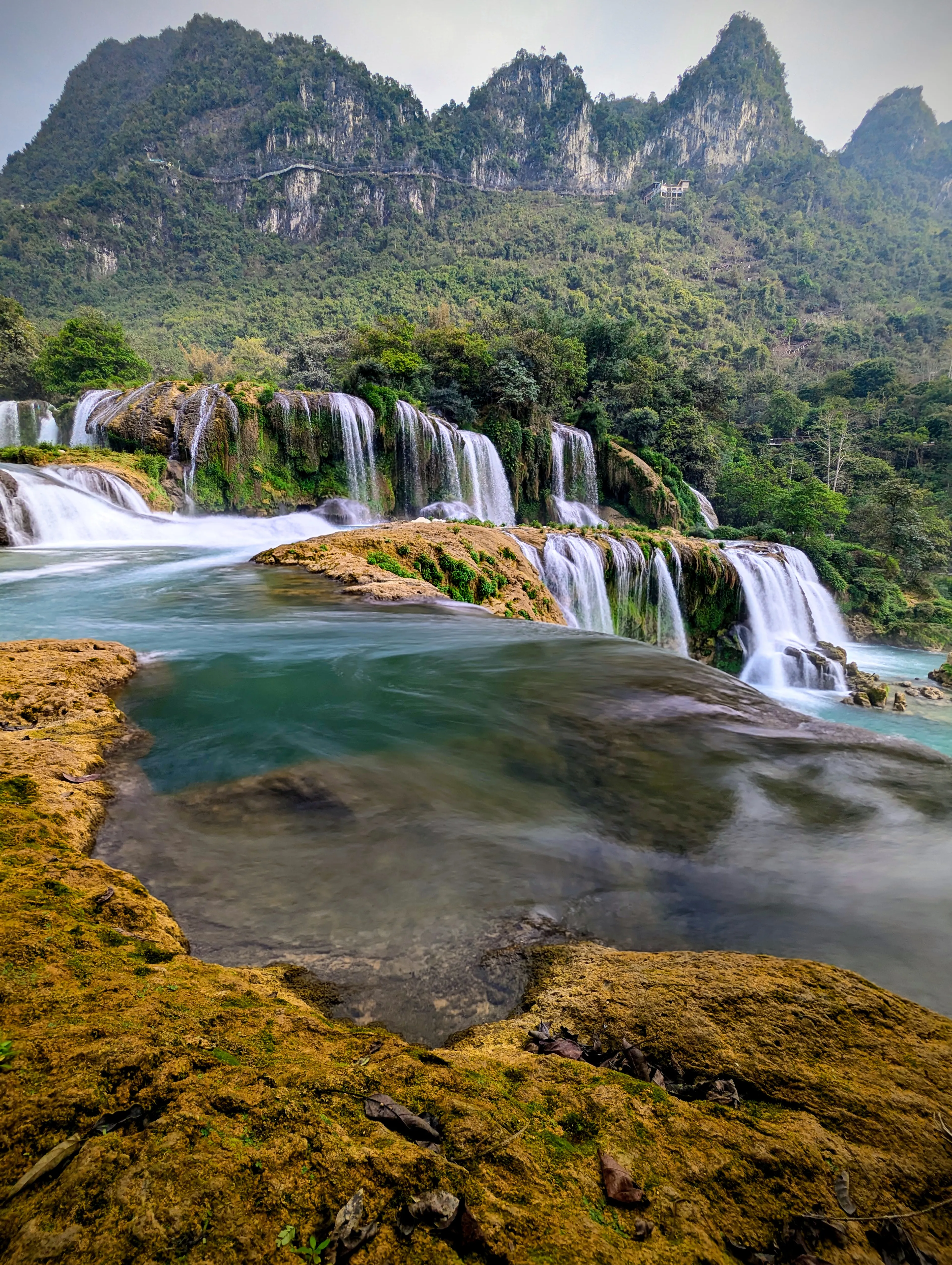
In this postcard: Lunar New Year in Hanoi, hitchhiking to Cat Ba Island, rusty towers in Bac Son valley, the Ban Gioc waterfalls, and a small reflection on kindness and reciprocity. I hope you enjoy this edition of Live and Learn.
Lunar New Year (Tet) in Hanoi
At some point during the Tet dinner, I am already completely full. I try to signal this politely, but the dad who invited Marc and me just smiles and gestures enthusiastically toward the dishes again.
More, he insists, pointing at the food and then at me, smiling as if fullness were beside the point.
I laugh and take another bite, but inside I feel that familiar discomfort creeping in—the feeling of taking up too much space, of accepting too much hospitality from somebody else. This isn't fair to them, I think to myself, while I munch some more, feeling slightly guilty.
The last few weeks have been filled with a lot of beauty. I have eaten more Pho than I ever thought possible and enjoyed the Vietnamese New Year in Hanoi. Hanoi is a beautiful city in its own right, with little details, hidden corners, and quirky places strewn throughout the city. The vibe is vibrant—the city buzzing with life at every corner.
Tet in Vietnam is like Christmas, New Year, and Easter rolled into one. The entire country pauses—shops close, streets empty, families travel home. And the skies in Hanoi clear up from the pollution as the streets empty of motorcycles and cars.
For a few days, you can enjoy the blue sky in this crazy city.
People stop working and go home to the places where their families live, where they grew up. Families enjoy this time together—eating lots of traditional home-cooked food (especially a rice cake called Banh Chung). They go to Pagodas and temples with offerings, stacking up food and Coca-Cola cans, apples, and other fruits into little pyramids and piles, to remember and worship their ancestors. It's a way to pray and ask for a good and prosperous New Year.
They also set off firecrackers and burn a lot of paper money and other little paper charms. I saw people set a little paper pony on fire, something that made me chuckle because it felt almost comically appropriate for the Lunar zodiac year of the Fire Horse. They do all of these things to have good luck, more money, prosperity, and health.
People here also gift red envelopes filled with a bit of money to each other. These red envelopes are supposed to bring luck to the receiver.
Many buy exquisite cherry and peach blossom trees and branches, as well as lanterns and little red flags to decorate their homes. The branches explode into pink blossoms across the entire city. It is lovely to spot them, on the backs of motorcycles, in front of homes, everywhere.
When you are invited to Tet by a Vietnamese family, you will get lots and lots of food. And when you think that you are already full and you can't eat anymore, then more food comes, and people will feed you, insisting that you eat at least another bite...
And when you think finally, that that was it—that you can never eat anything again—then somebody will bring dessert, and you at least have to try that too.
In Vietnam, feeding people is its own form of affection. Not symbolic affection. Not polite affection. Literal affection—measured in bowls of food.
Reciprocity in Kindness
It's wonderful and makes me so happy to be part of a tradition like this, to be invited, even though I am a complete stranger. What struck me most, though, was not just the food—it was the generosity.
Sometimes I feel a bit sad about not being able to give something back.
Sure, bringing a small gift is normal and appreciated, but something about this situation still strikes me as imbalanced.
It brings out the deeply nested German in me. In Germany, there is a strong idea of reciprocity when it comes to being generous. This runs so deep that I often find it difficult to simply accept when someone gives me something. I feel a strong urge to reciprocate immediately—to restore the situation to something "even."
Yet, that often misses the point of giving and receiving. It takes away something meaningful from the interaction. Even after years of traveling in all kinds of places and seeing that this is something that doesn't exist in many other cultures, I still can't silence this mental tallying system.
It stays in my mind, persistent.
And I often catch myself evaluating how much I receive and how much I give, feeling bad if things get out of balance in either direction.
Receiving generosity often makes me uncomfortable. I feel the urge to disappear—not because I dislike kindness, but because I cannot repay it.
There is this almost monetary, transactional aspect to it that I grew up with and have deeply internalized. If somebody gives me, say, around 10€ worth of something, I feel like I should give them back 10€ worth of something, otherwise the situation feels bad. It's very cultural, and I can see it reflected when traveling with other people, for example, when splitting bills. I've recently learned that this is called "Going Dutch", but it could equally well be called "Going German".
This cultural tendency of exactness makes me sometimes incapable of "true" kindness, because this mental tallying system engages all the time. I instinctively count both what I receive and what I give, trying to keep the two balanced, even though I know that this is, on some level, misguided.
Giving in Germany is therefore often done with the expectation of getting something in return. I had situations where people got angry at me if I didn't reciprocate enough. Even worse, in the past, I also got angry or annoyed at others if they didn't reciprocate "enough". I call this "conditional kindness", and it's a part of my own psyche that deeply frustrates me.
These ideas came up often while traveling with my friend Marc. He shares many of these notions, and sometimes we can chuckle about our German tendencies together.
Right now, we are just goofing around with playful energy, though, traveling through Vietnam and now Indonesia. Life is really good and easy going.
Cat Ba Island
A few days after Tet, we hitchhiked to Cat Ba Island, a misty extension of the famous Ha Long Bay—a bit less touristy but with the same mystical and world-famous Karst mountain systems stretching out into the water.
It was absolutely magical to go hiking and on a boat tour there. But the caves were the real surprise.
On the way, we made some new friends, goofing around as a group, going on hikes, exploring cave systems, and climbing up into the National Park to see the karst mountains disappear into the mist on the horizon.
Overall, we were just enjoying life tremendously.
I remember sitting there together after a hike, like on a school excursion—eating cheap ice cream from a local mom and pop shop, and just being there—happy about life and everything.
Bac Son Valley
A little later, we returned to Hanoi to meet with our friend Harsha to continue North towards the Chinese border to a place called Bac Son.
Bac Son is a rainy and quiet small town, nestled in a valley between massive karst mountains with a small river running through it.
Kids around here greet you every time they see you with the most enthusiastic "hello's" and "how are you's". It feels like you are the first foreigner they have ever seen.
There are horses slowly munching on the weeds growing in a nearby field, a slight but constant drizzle of rain, and the misty clouds overhead. It's a nightmare to find vegetarian, much less vegan food, but there are small coffee shops and local cafés, some of which sell fruit salad and boba tea.
It is delightfully slow-paced—a little bubble, mostly sheltered from the otherwise much more touristy areas of Vietnam. There are a couple of homestays now, but no specialized places catering to the every need of tourists. It still feels authentic, somewhat raw.
Climbing on top of the nearby Na Lay mountain gives serene views.
Marc and I even climbed up a little higher on top of a rusty old telecommunications tower. Slightly illegal but definitely a lot of fun.
Can you imagine the wind and the creaking noise of the metallic ladder, up there? The view was incredible—worth the little adrenaline rush.
Cao Bang—Mountains with Eyes and Tiger Caves
After a couple of days in Bac Son, we continued further up North to Cao Bang province to visit the famous Ban Gioc trans national waterfalls near the Chinese border.
But the surrounding area of Cao Bang province has more things to offer: grassy rolling hills, a karst mountain with a hole-shaped cave right through the middle of it (appropriately named God's Eye mountain), the gargantuan Nguom Ngao (Tiger) cave system, and plenty of rivers, streams, and rice terraces everywhere.
Riding our little scooters alongside the winding roads, the beauty of the landscape keeps making us stop in disbelief. "How can a place like this exist?", we ask ourselves again and again. The whole ride was heavenly, and we all agreed that someday we will come back here and take our time exploring this area. Because two days were not nearly enough.
We had even more Pho and other good food along the way, and stayed in small homestays along the road. One of them had this adorable cat, and the people in the villages made big fires burning off the remains of the rice harvests, a spectacle, often combining with the colors of the evening sky.
Ban Gioc Transnational Waterfalls
The highlight of the trip was the Ban Gioc waterfalls: a natural marvel that is impossible to really comprehend just from the photos. But still, our photographers' hearts were all delighted with the impossible picturesqueness of this place.
Just look at the turquoise waters. Can you imagine the roar of the water and the fine misty spray in the air? And how exciting it is that on the other side of the river begins China? That the border runs right smack through the middle of the river?
We were there early in the morning and therefore could enjoy a boat ride just ourselves, no other tourists, just the three of us and the friendly boat driver, getting us close enough to the waterfall to see it in its full glory.
We then later climbed up to the first basin, trespassing some of the "sectioned off" areas to get a better view, and this was so worth it and made the overall experience just so much better.
Climbing on top of the basins and seeing this marvel up close was just magical. I even dipped my feet into the water, feeling the power of the stream tugging on my skin.
A favorite author
In the moments in between, there is this pull back into reading. I'm coming back over and over again to the writings of Maria Popova. Her essays often circle the same kinds of questions I find myself thinking about while traveling—generosity, beauty, and the strange miracle of simply being alive, here to witness all of this.
Something about her words always hits me hard and makes me want to return to her essays. Her writing has this draw inward... to a place within, a place of quiet, of solitude.
Reading her essays feels like sitting by a warm fireplace, in a comfortable armchair, with the soft smell of tea filling the room, pondering the mysteries of our existence in the universe.
It might be one of my favorite newsletters that I am receiving these days. Every time I read it, I step away with a renewed understanding and glimpse of beauty.
I step away in awe of how somebody can use language like that.
A quote that got stuck in my mind:
There are those rare moments when something jolts you awake and you glimpse that meaning out of the corner of your eye. You shudder with the thrill and terror of having touched the beating heart of reality, then fall back asleep into your daily life. The great challenge, the great triumph, is to keep awake the part of you that knows, and has always known, the truth about what it means to be alive.
– Maria Popova - (source)
What inspires me about her writing is how seamlessly she connects different worlds—science, spirituality, philosophy, beauty, art. She quotes widely, yet somehow merges everything into something uniquely hers.
In doing this, she lets you glimpse a bit of her soul, a look at what is behind. You can feel the presence, that there is somebody else there, another mind that you can almost but not quite touch.
I would like to create work like this, curating, assembling, bringing together my own little perspective, mixing all the things that I love and cherish deeply. In a way, these newsletters are my attempt at something similar.
Alternative Versions of Kindness
Traveling has taught me something about kindness that I try to remember. There are alternatives to my German cultural programming.
There are different systems of kindness out there:
- The spirit behind Couchsurfing or Hitchhiking, sometimes called "paying it forward".
- The notion of "universal kindness" or Karma.
- Even the Greek or Turkish version, where people continually invite each other
The truth is that the score doesn’t have to be settled immediately. It can stretch across a lifetime, across people and situations.
The idea is that even though you cannot reciprocate to this particular person right now, there may come a time later in life when you are the one with a car or a house to spare. And then you pay this same hospitality forward to somebody else. Who, in turn, will reciprocate not to you but to someone else in the future, and so on.
Sure, there is an asymmetry in the situation, but in the end, "the universe" will work it out somehow.
This, to me, seems like the much better solution. You are just kind whenever you can be and accept hospitality whenever it is offered to you, unconditionally: living a life that is overall more full and wholesome.
Importantly, you don't expect generosity from others. You don't rely on it, either. But when people are kind to you, you can accept it without feeling the need to reciprocate immediately.
You are not kind because you feel obligated to reciprocate.
No.
You are kind because kindness is the right thing to do. It is what makes us human.
Maybe the lesson is simply this: accept the kindness. stop measuring it.
Smile back. Pick up the chopsticks again. And take another bite.
And then, when chance presents itself, invite somebody else to food and insist that they, too, have another bite.
I hope this digital postcard finds you well and that life on your end is beautiful.
If you feel like it, reply—hearing your thoughts, ideas, and life updates is what makes writing them worthwhile.
That's all for this time. I hope something in here made your day a little more beautiful.
Have ideas for improving it? As always please let me know.
Cheers,
– Rico
Subscribe to Live and Learn 🌱
Join the Live and Learn Newsletter to receive digital postcards filled with beauty, travel stories and links to nice things I have found, every odd week or so.