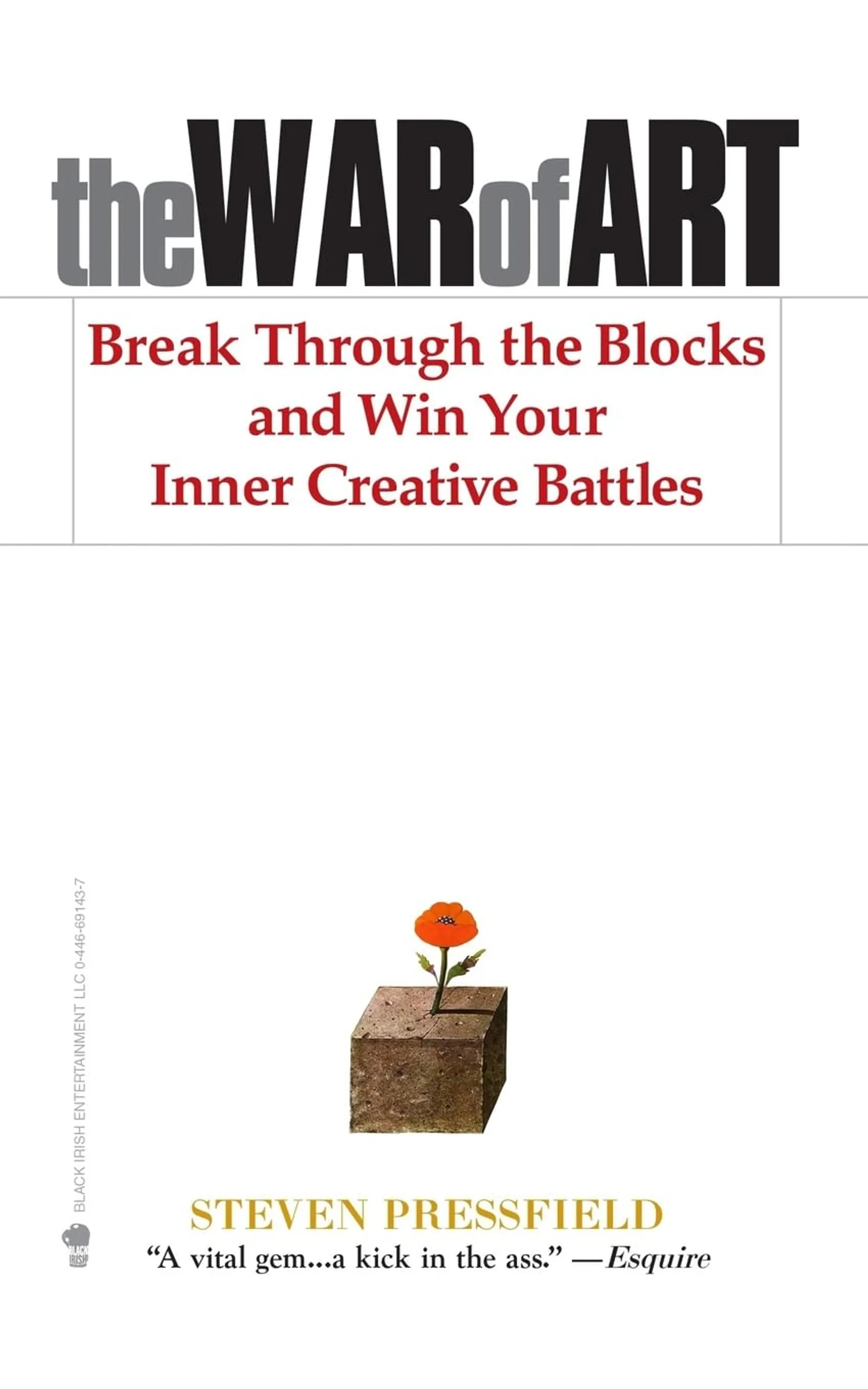
The War of Art
by Stephen Pressfield
🏆 Rated: 7/10
Summary
The War of Art is a book about fighting the enemy within, the Resistance, born out of fear (of success, failure, rejection, being wrong etc). This Resistance tries to keep us from creating art, with all kinds of self destructive tricks. We engage it in battle, every day, again, anew. it's a spiritual meaningful battle between good and evil running inside every one of us. The Soul is at stake. Resistance, as a part of the Ego, feasts on a life not lived, the shadow life, all the could have done this and could have done that's.
Often near death experiences help us to see this more clearly, to focus on the Self, to create and bring forth into the world what we we're always meant to. The Ego pushes back, it needs us to care about the opinions of others, to be validated, to seek approval, all just means to stop us from working, to destroy by limiting the hours we put in, hindering the creation from coming forth. The answer to this all is "turning pro". Taking this battle seriously, like an actual soldier, embracing all the suffering, the fear, the struggle that comes with it, and showing up every day, the whole day, no matter what. The answer I find a bit overwhelming and too much "hustle porn" adjacent, it's basically "suck it up loser and get to work" with a bit of mythical prose wrapped around it. The psychological ideas of dragons/myths/muses and angels existing in a higher realm in the last chapters, while esoterical to a degree that make me cringe, feel useful still. They hint at ideas of transcendence, of something deeper, and even if I'd put that stuff into the realm of "things we haven't understood about how our brains work" I can see how this is less useful than thinking of these forces as actually real. As energies and planes and beings of higher dimensions, the eternal holy realm, who actually wish to help us. Who want to see us succeed in bringing forth their creations, here, in our, limited world.
I think my favorite quote is at the very end of the book:
Creative work is not a selfish act or a bid for attention on the part of the actor. It's a gift to the world and every being in it. Don't cheat us of your contribution. Give us what you've got.
The question lingers... What is that for me? What have I got?
Detailed Notes
Foreword
When we sit down each day and do our work, power concentrates around us... We become like a magnetized rod that attracts iron filings. Ideas come. Insight accrete.
When inspiration touches talent, she gives birth to truth and beauty.
Chapter 1 - What I Do
Surrounded with lucky charms, trinkets from all over the world and friends, he goes to work, producing pages of writing.
Are they any good? I don't even think about it. All that matters is I've put in my time and hit it with all I've got. All that counts is that, for this day, for this session I have overcome Resistance.
Chapter 2 - What I Know
Writing isn't hard. Regularly doing anything is hard.
Chapter 3 - The Unlived Life
All the dreams we have but don't act on, lead to a shadow life. The things we know we want to be doing, but where we self sabotage and don't do them. The reason for this self sabotage => Resistance.
Late at night, have you experienced a vision of the person you might become, the work you could accomplish, the realized being you were meant to be? Are you a writer who doesn't sitter, a painter who doesn't paint, an entrepreneur who never starts a venture? Then you know what Resistance is.
Thought: This reminds me so much of the movie Everything, Everywhere, All At Once. Namely because Evelyn the lead character derives all her power from all her failures, all the different universes where she did something, instead of succumbing to the Resistance. Where she did live all those other lives. All the failed choices, all the failed directions that she could have gone down into, unrealized, actually being an advantage because of the way the movies universe is set up.
Resistance is the shadow and antithesis to our genius. Genius wants to create, Resistance wants to destroy, to stop us from creation. Freud called Resistance the Deaths Wish.
You think Resistance isn't real? Resistance will bury you.
Book One - Resistance - Defining the Enemy
Anything that favors long term growth over instant gratification is targeted by Resistance.
Resistance seems to be outside of ourselves. But it comes from within.
Resistance will tell you anything to keep you from doing your work. It will perjure, fabricate, falsify; seduce, bully, cajole.
Resistance can't be reasoned with, it's only aim is to destroy, to stop things from becoming real.
Though it feels malevolent, Resistance in fact operates with the indifference of rain and transits the heavens by the same laws as the stars.
Resistance points like a compass. If we try resisting really hard to do something, this is usually the thing most worth doing. The more our soul calls for it, the more resistance will try latching onto it.
Everyone who has a body experiences Resistance.
The battle must be fought anew every day.
Resistance doesn't go away. Ever. It is permanent.
Resistance tries to kill the heart of our person, what we are meant to be, Resistance wants that. Hence resistance has a direction (hence it can be used as a compass).
Procrastination is Resistance's best weapon. We don't tell ourselves we won't do it, we'll only do it tomorrow.
We don't just put of our lives today; we put them off till our deathbed. Never forget: This very moment, we can change our lives. There never was a moment, and never will be, when we are without the power to alter our destiny.
This second, we can sit down and do our work.
Sex and other positive gratification activities (TV, video games, traveling etc.) can be weaponized by Resistance.
The working artist will not tolerate trouble in her life because she knows trouble prevents her from doing her work.
Thought: All this speaking in metaphors reminds me of the ideas from Useful Not True. It's not about those ideas being correct. They might or might not be but I think that adopting them as if they were real would have a superb effect on life. Thinking of Resistance as a literal physical, mythological thing that's out to get us and eat us and our lives, helps to avoid it. It becomes tangible and therefore we can actually fight it. Even if that is just a crutch, and not real, it is very useful.
Resistance can be a collective activity. A family can do it together by creating problems that need taking care of. As soon as people could go back to their calling, there's another thing popping up that needs handling.
This is called self dramatization. When things could go into the direction of work... Do something to make life more messy and well... Don't do the work.
Thought: For me, this is traveling. It is the perfect thing to ratchet up complexity and not having to face my ideas. The things I want to be doing. Creation. Monthly projects. Music, writing, photography, painting etc. Everything can be stopped "safely" because I am traveling. The same is true for other good habits. This is Resistance at it's most sneaky.
When we drug ourselves to blot out our soul's call, we are being good Americans and exemplary consumers. ... Instead of ying self-knowledge, self-discipline, delayed gratification, and hard work, we simply consume a product.
The idea of the victim act, producing a crisis or sickness (mental or physical health related) as a way to get out of your work.
A victim act is a form of passive aggression. It seems to achieve gratification not by honest work or a contribution made out of ones experience or insight or love, but by the manipulation of others through silent (and not-so-silent) threat.
Casting yourself as a victim is the antithesis of doing your work. Don't do it. If you're doing it, stop.
I want to write down this page in full.
What does Resistance feel like? First unhappiness. We feel like hell. A low grade misery pervades everything. We're bored, we're restless. We can't get no satisfaction. There's guilt but sr can't put our finger on the source. We want to go back to bed; we want to get up and party. We feel unloved and unlivable. We're disgusted. We hate our lives. We hate ourselves. Unalleviated, Resistance mounts to a pitch that becomes unendurable. At this point vice kicks in. Dope, adultery, web surfing. Beyond that, Resistance becomes clinical. Depression, aggression, dysfunction. Then actual crime and physical self-destruction. Sounds like life, I know. It isn't. It's Resistance. What makes it tricky is that we live in a consumer culture that's acutely aware of this unhappiness and has massed all it's profit-seeking artillery to exploit it. By selling us a product, a drug, a distraction.
We unplug ourselves from the grid by recognizing that we will never cure our restlessness by contributing our disposable income to the bottom line of Bullshit, Inc., but only by doing our work.
Thought: This is essentially why the Matrix myth or stereotype is so powerful. Essentially we are trapped in a matrix. A mean, wrongful mother, trying to keep us "happy" and satisfied. This allies with Resistance. In a way the capital machinery is an invention of Resistance and Resistance is allied with Moloch to improve this trap forevermore.
The artist and the fundamentalist both confront the same issue, the mystery of their existence as individuals. Each asks the same questions: Who am I? Why am I here? What is the meaning of my life?
Thought: Answering these questions means overcoming Resistance because these questions can only be answered by living out the shadow life.
Thought: These questions also only arose with culture, society and modernity. Before agriculture there was only survival and therefore these questions didn't matter because your tribe gave you answers to all of this. These ideas also check out with what the first few episodes of Awakening from the Meaning Crisis talks about.
We know what the clan is; we know how to fit into the band and the tribe. What we don't know is how to be alone. We don't know how to be free individuals.
Modern life cuts the individual free and in this freedom we don't know how to act anymore and therefore often become miserable. This is the heart of the Meaning Crisis.
Artists and fundamentalists try to deal with this wound, but in different ways => constructive vs. destructive. Accepting and rejoicing in freedom vs. relinquishing it and attacking it for everybody else.
Thought: These ideas are mirrors of what has been written in Atlas Shrugged. You can use creativity for both purposes.
Fundamentalism and art are mutually exclusive. ... This does not mean that the fundamentalist is not creative. Rather, his creativity is inverted. He created destruction.
Things do progress, life does evolve; each individual has value, at least potentially, in advancing this cause.
Thought: But there exists a crosswind. Link to the Mandelbrot Optimist Playbook.
The truly free individual is free only to the extent of his own self-mastery. While those who will not govern themselves are condemned to find masters to govern over them.
Resistance mostly harms ourselves. But criticism of others harms them too.
Fear is good. Like self-doubt, fear is an indicator. Fear tells us what we have to do.
If it meant nothing to us, theref be no Resistance.
Sometimes we are afraid to loose our friends and social network if we embark on a journey to do something. This fear is Resistance in disguise. We don't push ourselves to do what we need to do in order to be complacent with life.
The part of us that we imagine needs healing is not the part we create from; that part is far deeper and stronger. The part we create from can't be touched by anything our parents did, or society did. That part is unsullied, uncorrupted; soundproof, waterproof, bulletproof.
Thought: This to me sounds like toxic masculinity and hustle culture. There's a deep problem in this related to leisure and how that's necessary and how wounds emotional and traumatic shouldn't be pushed aside. Living by this maxim is a way to accumulate damage as well and then not be able to produce anymore. It's not taking care of P/PC balance as Steven Covey would say.
Resistance can abuse healing (or preparation) as a weapon though. Sometimes we are healed enough and ready enough and need to do the work.
Rationalization is Resistance's right-hand man. Its job is to keep us from feeling the shame we would feel if we truly faced what cowards we are for not doing our work.
Real life problems can be valid, but they most often are not a hindrance to our work if we decide that they aren't. Im that decision is power.
Book Two - Combating Resistance - Turning Pro
The antidote to Resistance is dedication. Loving something so fiercely that we dedicate our life to it. That's "turning pro".
Rituals and habits build inspiration.
Artists have to know how to be miserable. Because the life filled with acts of creation is often that: miserable. Lonely, rejected, ridiculed, humiliated.
What are the qualities that define us as professionals?
- Showing up every day.
- Showing up no matter what.
- Staying for the day.
- Staying for the long haul.
- High and real stakes
- Compensation
- No over identification
- Mastery/Craftsmanship
- A sense of humor
- Praise/Blame in the real world => accountability.
The professional loves the game but not too much, playing for money 'helps' with a cold blooded demeanor. You care less => hence you become more effective.
Treating art like a war, slugging it out "day after day", in snow and rain.
Thought: All of this sounds incredibly sad. Like in order to do something you need to stop loving. Stop enjoying it. That to me seems stupid it robs the creative act of it's purpose.
Resistance wants us to over commit. To work in short bursts. Never finishing anything. We feel like we're working. But there is no consistency and nothing ever gets done in these "fits".
"Pros" are patient.
The artists keeps order in his life, in order to make space for creation.
Thought: This directly contradicts much of a whimsical artist stereotype that also creates art and thrives in chaos. The wizards lair sort of vibe. It's a very not nuanced way of seeing the world. Authoritarian, white, Christian sort of view of things. It's a bit obnoxious.
The professional masters how, and leaves what and why to the gods.
Every day, we should be prepared to confront our own self sabotage. That's what it means to fight the Resistance.
The professional identifies with her consciousness and her will, not with the matter that her consciousness and will manipulate to serve her art.
Evolution has programmed us to feel rejection in our guts. This is how the tribe enforced obedience, by wielding the threat of expulsion.
The battle is inside our own heads. We cannot let external criticism, even if it's true, fortify our internal for. That for us strong enough already.
Book Recommendation: Bhagavad Gita
We have right only to our labor, not the fruits of our labor.
Criticism should be ignored, if it doesn't have an actual point. If it does have a point. There's something we can improve. And that's good. If it's criticism for criticisms sake, it's like a compliment.
The critic hates most that which he would have done himself if he had had the guts.
The idea of being Myself, Inc.
Book Recommendation: The Searchers
Pros are more persistent than Resistance. They'll go on and on, trying again and again, every day, as long as they live.
Turning Pro is simply a decision.
Book Three - Beyond Resistance - The Higher Realm
There are forces we can call our allies.
Call them muses, angels, or "talent" but there is something going on that every once in a while helps us to create art. Inspiration strikes.
The most important thing about art is to work. Nothing else matters except sitting down every day and trying.
The Knights of the Round Table were chaste and self-effacing. Yet they dueled dragons. We're facing dragons too. Fire-breathing griffins of the soul, whom we must outfight and outwit to reach the treasure of our self-in-potentisl and to release the maiden who is God's plan and destiny for ourselves and the answer to why we were out on this planet.
Thought: I like this mysticism embedded here somehow. It's like taking myth as a way of dealing with the problem of motivation, coming up with nice stories of cosmological significance in order to tap into another layer of our brain and help us fight something that otherwise isn't "visible" or fightable even because it just exists in our head somehow. At the same time I feel like the author really believes in these things, not just as metaphors and "hacks" but as in angels and Gods are real and this is a mythical battle of the forces of evil vs. good. To me this seems somewhat awkward.
Book Recommendation: Phaedrus - Plato
The ancients sensed powerful primordial forces in the world. To make them approachable, they gave them human faces.
Where did Hamlet come from? Where did the Parthenon come from? Where did Nude Descending a Staircase come from?
Eternity is in love with the creations of time. – William Blake
The gods want to listen to their creations, they help humans bring them about because they want those things to exist. The eternal participating in the non eternal, bringing about "wonders" through humans. Genius is the ability to hear and respond to that whispering of the muse. To bring about the "will" of the gods.
Book Recommendation: Odyssey - Homer, T.E. Lawrence Translation
Whatever you dream you can do, or dream you can, begin it. Boldness has genius, magic, and power in it. Begin it now. – Goethe
What software is grinding away, scanning gigabytes, while we, our mainstream selves, are otherwise occupied? Are these angels? Are they muses? Is this the Unconscious? The Self? Whatever it is, it's smarter than we are. A lot smarter. It doesn't need us to tell it what to do. It goes to work all by itself. It seems to want to work. It seems to enjoy it.
Thought: Probably Daniel Kahnemann would call this System 1 thinking. Default mode network. But it is still odd, where does this inner voice come from? Producing insights while we are taking showers? What do our brains do?
Chaos itself is self-organizing.
Clearly some intelligence is at work, independent of our conscious mind and yet in alliance with it, processing our material for us and alongside us.
Where did this dream come from? Plainly its intent was benevolent. What was its source? And what does it say about the workings of the universe that such things happen at all? Again, we've all had dreams like that. Again, they're common as dirt. So is the sunrise. That doesn't make it any less of a miracle.
When we face death, things shift into focus. They become clear, we know what we want. Our shadow lives step in the light, regrets become visible, paths taking shape, priorities resolving, clear as day. We shift from the Ego to the Self and this changes our entire viewpoint.
Angels exist in the Self. Resistance exists in the Ego. The fight is between the two. Between Ego and Self. Creation can be co-opted and motivated by the Ego, that's why amateur artists get so hung up on criticism. It's not the result and the perception that matters to the Self. It's the act of creation itself. The ego only cares about the result. How we look.
When we deliberately alter our consciousness in any way, we're trying to find the Self.
The kid taking ecstacy at a rave. The monk in meditation. The whirling dervish. The chanting Yogi. They all search for it in their own ways.
Another page I want to quote in full:
The Self is united to God. The Self is incapable of falsehood. The Self, like the Divine Ground that permeates it, is ever-growing and ever-evolving. The Self speaks for the future. That's why the Ego hates it. The Ego hates the Self because when we seat our consciousness in the Self, we put the ego out of business. The Ego doesn't want us to evolve. The Ego runs the show right now. It likes things just the way they are. The instinct that pulls us toward art is the impulse to evolve, to learn, to heighten and elevate our consciousness. The Ego hates this. Because the more awake we become, the less we need the Ego. The Ego hates it when the aspiring writer sits down at the typewriter. The ego hates it when the aspiring painter steps up before the easel. The ego hates it because it knows that these souls are awakening to a call, and that that call comes from a plane no let than the material one and from a source deeper and more powerful than the physical. The Ego hates the prophet and the visionary because they propel the race upward. The Ego hates Socrates and Jesus, Luther and Galileo, Lincoln and JFK and Martin Luther King. The Ego hates artists because they are pathfinders and bearers of the future, because each one dares, in James Joyce's phrase, to "forge in the smithy if my soul the uncreated conscience of my race." Such evolution is life-threatening to the Ego. It reacts accordingly. It summons its cunning, marshalls its troops. The Ego produces Resistance and attacks the awakening artist.
We're not born with unlimited choices. We can't be anything we want to be. We come into this world with a specific, personal destiny. We have a job to do, a calling to enact, a self to become. We are who we are from the cradle, and we're stuck with it.
Humans like hierarchies from a psychological viewpoint. It gives us psychological security, we understand them intuitively, but the world has gotten way to big for our brains to handle hierarchies of that scale. Hence we feel lost in the masses, not knowing our role to play, our place in the hierarchy, where we are. There's just too much going on, too many other people to keep track off.
Artists can't be part of hierarchies because I'm hierarchies you act for others. Artists have to act for themselves.
The hack: somebody who panders more to the audience and what the audience wants rather than their own taste. They sell their muse to create the most effect/money in the market.
Thought: Even worse, our algorithmical world panders to this beautifully, the metrics and a/b testing what works are so available that everybody has to do it, else they won't be discovered. Hence art is destroyed from the point of view of the masses. Movies get worse. YT becomes Mr. Beastified and writing becomes "copy-writing" or content marketing... This makes me tremendously sad.
Territories are places where we do an activity over and over until the place itself becomes charged with power. Giving back energy because of the habit the place stands for. We connect the place and our peak experience.
As the mother-to-be bears her child within her, so the artist or innovator contains her new life. No one can help her give it birth. But neither does she need any help.
Of any activity you do, ask yourself: If I were the last person on earth, would I still do it?
We must do our work for its own sake, not for fortune or attention or applause.
We are servants of the Mystery. We were put here on Earth to act as agents of the Infinite, to bring into existence that which is not yet, but which will be, through us.
Are you a born writer? Were you out on earth to be a painter, a scientist, an apostle of peace? In the end the question can only be answered by action. Do it or don't do it.
Creative work is not a selfish act or a bid for attention on the part of the actor. It's a gift to the world and every being in it. Don't cheat us of your contribution. Give us what you've got.