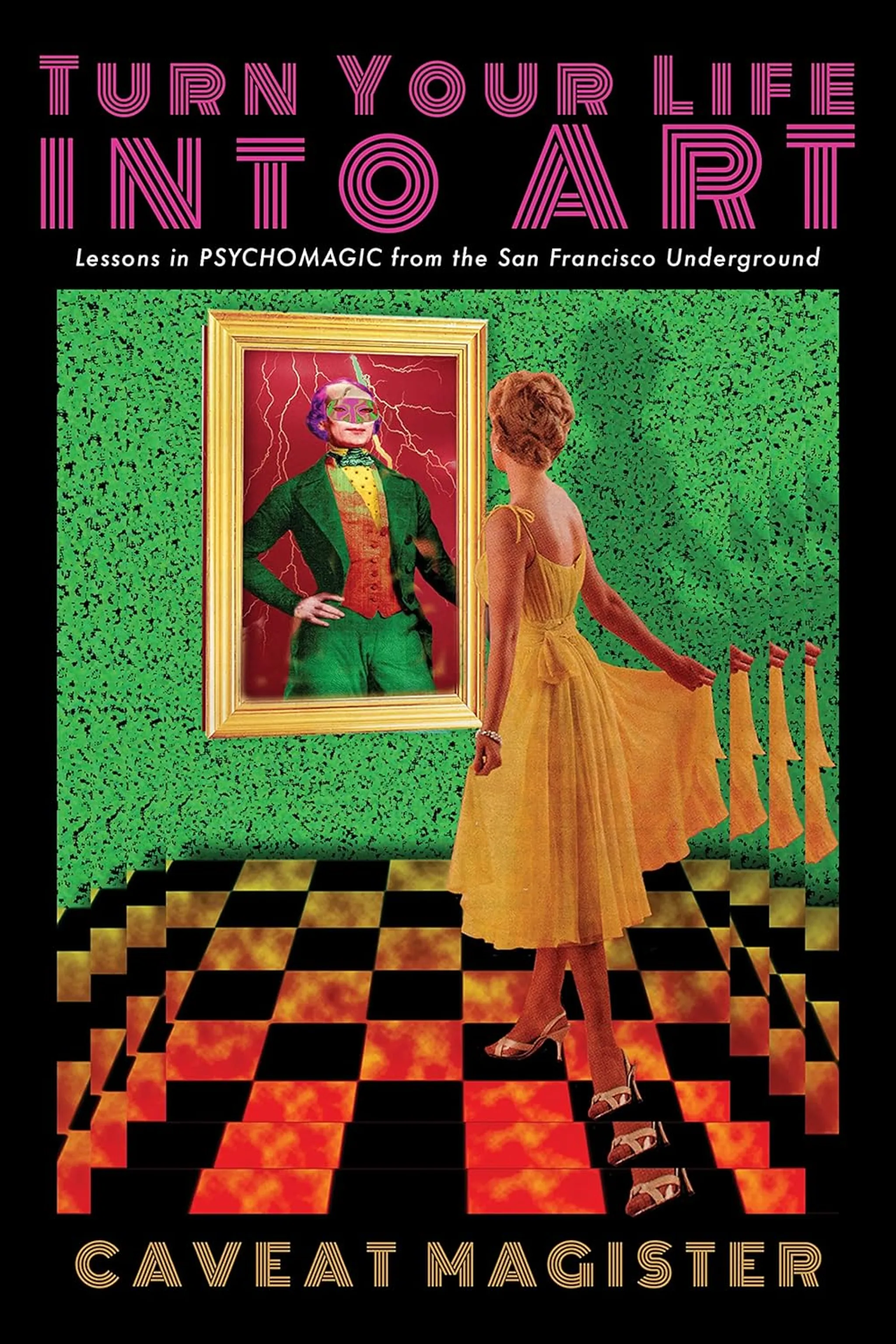
Turn Your Life into Art
Lessons in Psychomagic from the San Francisco Underground
by Caveat Magister
🏆 Rated: 9/10
Summary
Turn Your Life into Art - Lessons in Psychomagic from the San Francisco Underground is a beautiful book about how to design powerful experiences that are capable to change the life trajectories of other people by engaging parts of their subconscious. It also talks about why you might want to do this and the broader societal implications of this, while being a little bit of a historical account and an overview of examples of what the art scene out of which Burning Man grew did in San Francisco during the years that it was operative in. It is written by Caveat Magister, one of the people who helped build a lot of these experiences and was there for a lot of this magic, as it happened, helping shape a few of those events himself and therefore knows what they were doing.
The main idea behind Psychomagic is that you need to offer something real, something that isn't staged, it is more about "channeling" or "tuning in" rather than performing, to go with where the subconscious of the other person will take you and reacting to that in the moment. It is heavily laden with ideas of psychology, especially some ideas from a Jungian perspective, where magic enters the picture as archetypes and synchronicities. The book doesn't believe in real magic, but it's talking a lot about how our brains perceive the world around us in sort of magical categories and how these ideas of magic can manifest themselves for all intents and purposes in ways that feel magical. Where short moments of experience can transcend the mundane of our day to day lives and invoke truly transformational individual change. And there is something beautiful about this and something that is as close to magic as you can get without believing in "supernatural forces". In this the ideas are very close to ideas around Shamanism and why those types of experiences work and also clearly tied to the work of Jodorowsky who coined the term "Psychomagic" in the first place.
To me, the best part where all those stories and examples throughout the book, that stick with me. The bar that makes unique, once in a lifetime drinks to answer people's highly personal in the moment prayers. The Circus Redickuless and that you could run away with it after watching their show and change your life that way. The summoning of the author through singing Hallelujah in a theme park they broke into as a group where he got lost in the woods. The idea of eating dinner at night time in front of the statue of the Gates of Hell. The story of the mobile dance party dancing through the streets of New York or San Francisco. The bidding wars between two people bidding for 20€ digging their own hole because they can't accept the sunk cost and the drama that ensues from that. The Santa giving a kid a toy "for free" in a store at Christmas even though the "Santa" is not associated with the store at all.
Detailed Notes
Section 1 - Who We Are and What We're Looking For
Experience Design => turning the mundane into the ineffable
A how to for turning your life into art.
The experiences that fundamentally change lives. That touch souls. That feel like impossible magic, rather than merely good design.
It's not just about talent it's about what you're willing to risk.
Chapter 1 - Nightlife as a Spiritual Pursuit
The story of the bars Plutonian ideal as a church that answers prayers in drink form.
What mattered to them was the experience they had, and the connections they made with other people through it.
Why do people go to bars and clubs so often? It's not to meet friends. It's not to drink alcohol. It's not to get laid. None of these are sufficient to explain the phenomenon. It's because they want to have an experience.
They want an experience in which something unexpected can happen and they can play a role in it.
It's about memorable encounters with the unknown. Let's go to a bar is expressing the desire for something unexpected to happen.
Over time, I’ve come to see nightlife as being a kind of spiritual pilgrimage: the quest for a bar experience is a quest for the holy grail. We go to the club hoping to have a miraculous encounter, to be part of moments that cannot be recreated.
I found dancing with prostitutes in a Russian nightclub to be as spiritual an experience as singing Latin plainchant in a Swiss cathedral; partying at a tequila bar just outside Jerusalem’s Old City to be as religious as kissing the Wailing Wall; and running away from the Verona police with two Dutch girls and a Croatian woman to be as holy as living in a Buddhist monastery in India.
Bar experience - unexpectedness in the conversation igniting your soul, a meaningful encounter
Club experience - about the raw sensation, the dancing, the overwhelmingness of it
The third - you were touched by something, akin to falling in love, you glimpsed the potential for change but don't quite know why or what happened
These experiences are the rewards for quests. This needs design, that is what this book is about. How to create quests that lead to these experiences.
They’re experiences that, like the Holy Grail, you probably have to go on a quest to find, leaving your comfort zone and entering new environments filled with mysterious and strange people.
Thought: In a way, traveling is a weird way of going on these quests. There is something about it that ties into that same realm of going for the unexpected, something meaningful that I can participate in and play a role in.
When you understand what drives people, you can turn a trip to the mall food court into a life changing magical moment.
Chapter 2 - The Unexamined Psyche
The story of how people stand in their own ways when playing DnD characters secretly designed to follow their own heros ark aspirations. Self sabotaging because their subconscious won't even let them play as that character because it hits too close to home and they have internalized that they can't be this aspirational version of their selves so they fail, even if they need to embody it in a fictional game setting.
For whatever reason, there are things happening in our unconscious mind, and they impact what it is we can do in the world, and who we can be.
Different cultures – and different thinkers within cultures – have had different explanations for what the “sub-conscious” and the “unconscious” are. The ancient Greeks thought of it as a connection to the gods. The Muses inspired you, the Furies tormented you, gods and goddesses could give you ideas or drive you mad with desire, change you into a bestial state or elevate you to the stars. You can take that literally (if you want), but you can also see it as metaphors for psychological states that we all go through. What caused them? It was the divine acting through us. Our connection to the transcendent in the universe.
Existential Integrative Psychology => Kirk Schneider and Orah Krug
Go through levels of determining where your behavior comes from from psychological towards soulful:
- Physiological
- Environmental
- Cognitive
- Psychosexual
- Interpersonal
- Experiential
The core of our being – the existential condition that we always live in. Embracing the mystery of your full humanity, with its attendant limitations. You are a body, and you will die, and you have only so long in which to make meaningful choices, but you are here, physically present, right now.
Fairly often, surprisingly often, and at our most profound moments, that is what we actually experience in our lives. Even if it’s not the least bit true (and hey, it might be), we experience magic, and destiny, and the divine. We live the unconscious as a connection to those things.
Thought: This is why certain YouTube videos hit so hard, and why Awakening from the Meaning Crisis is so popular. It acknowledges this. Also Kirtan and ecstatic dance come to mind and also somehow certain CI workshops and jams. Also being the guest of the month too.
Chapter Three - The World as We Live it is a Magical Place
The book author being summoned by a song being sung of Hallelujah because it had meaning to him and so he had to join in on singing it even if he only heard it faintly across the park.
Am I seriously saying we are touched by the gods, that our souls have destinies they want us to fulfill? That the world is an enchanted place? No, but I’m saying we experience it this way. We experience it this way at the very core of our being. There’s no use denying it. What should we make of this? Does this mean we have to take gods and souls and destinies seriously? Or that, because of its siren call, we must reject enchantment all the harder in order to support rationalism?
Book Recommendation: Love and Will – Rollo May
What we are to make of the gods and demons and enchantments that our (psychological) world is full of. We cannot take them literally, May said, because to do that is to return to superstition and lose our ability to think carefully about them. But … We also cannot think of them as wholly symbolic, because to do that renders them bloodless and powerless, and thus stops describing the experience of them that we actually have – wherein they are tremendously powerful, tremendously vital and alive, and tremendously real. We have to treat them as neither literal events nor entirely psychological ones. To understand these experiences, we have to understand them as operating on multiple, sometimes contradictory, levels. Levels that come together to create an experience that is extremely powerful, even magical, offering catharsis and insight we need.
However rational we get, however much we learn about the world, we do not “outgrow” the unconscious, or the way that it speaks to us in ways that seem – and perhaps even are – enchanted.
Awe and wonder are fundamental to being human.
Chapter 4 - The Psyche Moves in Mysterious Ways, its Wonders to Perform
The theoretical framework doesn't matter for experience design. Both Freud and Jung and a bunch of others work. It tends towards "Neo-Jungian"
Being on auto-pilot serves to put us in boxes of our own making, where we don’t really feel alive. But most of the time it’s still a pretty good idea. I mean, if you had to carefully think through the sequence of events every time you got up in the morning, you’d never get to work on time.
Much of the time it’s okay, even really useful, to be creatures of habit.
Series of significant automatic behaviors to triggers are called complexes.
We find ourselves repeating the same relationship over and over again, no matter how many times we tell ourselves we’re going to do something different this time; we fall into the same social role with our friends, no matter how much we try to break out of it; we sabotage ourselves at work in the same ways over and over again; we start projects and never finish them because of an escalating anxiety we do not understand … we suspect, sometimes, that there’s something going on under the surface, some underlying cause for these repetitions, but no matter how hard we look, we can’t see it. Often we’re the only ones who can’t see it: it’s so obvious to everyone else, but their pointing it out rarely helps.
Stepping out of complexes literally feels like magic because it creates possibilities where there previously were none.
Experience Design => "liberate people from their habitual ways of looking at the world, and free them from their complexes."
Archetypes are rarely defined very well but we can all tap into them and understand them because they leave that wiggle room for personal interpretation. That makes them powerful.
Numinous - expansive, full of creative energy
Book Recommendation: The Archetypes and the Collective Unconscious - C.G. Jung
Book Refommendation: A Psychological Approach to the Trinity - C.G. Jung
Much in the way that everybody has an unconscious, and it’s running much of our lives in ways we don’t even notice, every unconscious has archetypes. Has a personal mythology. And it’s when you can reach that level of the unconscious where the archetypes dwell, or summon them into the level of your consciousness, that you get this magical, numinous, effect.
When you can reach someone’s personal mythology, you’re reaching them on a level where magical things happen. That’s the point. And personal mythologies are made up of archetypes, which are symbols that are at once personal and universal.
Chapter 5 - Meet the Daimon
The circus Redickuless - a show without any talent, all acts bizarre and somewhat stupid - but anybody could join it and have their own act from the audience. And people did join. It was life-changing for many.
They learned a set of skills that most people don’t even know exists. It’s not easy to turn bullshit into magic – it’s the psychological equivalent of turning straw into gold.
People who are euphoric make stupid decisions, to be sure. But people who have breakthrough experiences … from building a temple, from becoming a clown, from confessing one’s darkest secrets to a visiting spirit … usually find that the decisions they make are good ones.
Don't marry your parakeet.
Why do the most dizzying and intense experiences of our lives not leave us dazed and confused, but rather infused with a new sense of purpose, resolve, and a higher sense of self?
Self-actualization [...] is the highest human need. We can’t get to it until we’ve handled the basics – safety, shelter, food, community – but there is a drive in us all to grow into ourselves – to become what we are capable of.
Jung calls this self actualization process => individuation.
Resisting this process is bad. It literally drives us crazy in all kinds of ways. Yet most of us resist it most of the time. Isn't that weird?
The truth is that most of us resist individuation much of the time. It’s not really convenient for the lives we live, or the world we live them in. We stay in jobs that don’t engage us because we need the money; we stay in relationships that don’t fulfill us because we’re stuck in a rut, or we don’t get into relationships we want because we’re frightened; we stay in places we’ve outgrown because we’re lazy or afraid of change; we hold on to habits that make us unhappy because they also make us feel secure; we avoid confrontations and conflict that we need to have because they make us feel uncomfortable; we refuse to connect with something greater than ourselves because we don’t know how to be humble.
Happiness, Aristotle wrote, is to live in harmony with one’s daimon. “Eudaimonia” is to achieve happiness through living up to one’s potential, achieving excellence in your virtues, and being who you are meant to be.
Daimon is the idea of who you are meant to be as a sort of magical destiny concept from the Greeks.
When we have set up a life that gives us no more room to grow, or to grow in ways that are intrinsically meaningful to us, the daimonic acts out against it. The more we repress our potential to be authentic, the more extreme the daimon’s reaction eventually becomes.
If we are suppressing our own growth into who we authentically wish to become, if we are surrendering ourselves to an agenda we do not really care about, then the daimonic will not listen to reason. It will be as irrational as it needs to be to get us on track.
Emotions are, in fact, an objective phenomenon, and learning to interpret them isn’t irrationality but wisdom.
Human beings have real spiritual needs, even though the spirit isn’t real.
Spirituality => the weirdness that happens when matter starts to experience psychology.
Book Recommendation: How Clients Make Therapy Work - Art Bohart
Just like our bodies are self healing our psyche's are too. We go to a therapist only when this self healing is not enough anymore, when the amount of damage is overwhelming in the same way that we go to a doctor when that same thing happens in the physical realm.
We encounter so many setbacks, mental bruises, minor traumas and depressions, in our day-to-day life, and we generally don’t need a therapist for them. That’s because we have a capacity for self-healing and growth. We don’t need a professional’s advice, we’ve got this. But when our capacity for self-healing is somehow stalled, or is overwhelmed, or we suffer a truly traumatic psychological injury that is too much … then we see a therapist.
And the therapist just helps us jumpstart or rediscover our ability to self heal.
The thing that matters here isn't technique but an authentic connection to another human being that really cares about your well-being.
Chapter 6 - An Introduction to Psychomagic
Our conscious minds are not the entirety of our psyches, our selves – just the parts we’re aware of (literally that we’re “conscious” of), moment to moment. Beneath that is an unconscious realm that, though we’re not routinely aware of it, has a tremendous impact on the way we see the world, and the way we see ourselves. It influences our assumptions, our choices, and our sense of what’s possible, in ways we’re not aware of. And each of us, as we go through life, develops a personal mythology within our unconscious – stories and symbols emerging out of our lives that represent what our unconscious, and therefore we, make of the world and ourselves. Within that unconscious is a drive to individuate, to grow and become our full selves, and it’s a powerful urge. But in most people it is routinely thwarted by the lives we live. That thwarting doesn’t just happen with the decisions we consciously make: it happens at the unconscious level, too, which is why despite our explicit desires to break out of old patterns, lift ourselves out of ruts, and take new kinds of risks to get new kinds of outcomes, we so often find ourselves repeating the same behaviors, and mistakes, again and again and again. Our need to individuate is thwarted by the complexes we develop, and the way in which we project the parts of ourselves we’re unwilling to acknowledge onto other people, who have no idea that they’re part of our psychodrama. We want to change, we want to grow, we want to be authentic in the world … but much of that work has to be done on the unconscious level, and we don’t have direct access to it.
When done correctly the Daimon helps. Because the Daimon is highly personal, the person facilitating the experience needs to channel rather than perform. They need to be in tune with the other person and where there Daimon wants to lead and for that they need to be genuinely attentive.
Over 30 years, San Francisco’s artistic underground developed a series of tools to create psychomagical experiences, which speak directly to the unconscious minds and personal mythologies of people going through them, thereby supporting their process of individuation and having an effect that is, often, life changing.
Chapter 7 - Success Looks Like Serendipity
A lot of people pull out the old standby that, look, coincidences are actually a statistically probable event, and they’re going to happen somewhere, sometime, so it might as well be here. I tried that one for a while, but it didn’t last. Even if that’s true, something is happening to cluster these coincidences at these events. So you could say, okay, that’s a selection bias, but now you have to propose some kind of mass selection bias effect and … I don’t know, it could be true. It could be. It just … … look, when this actually happens to you? You can’t help but wonder: WHAT KIND OF WORLD AM I LIVING IN?And when it keeps happening? You eventually start to think that maybe things you didn’t think were possible are, in fact, possible. Which, of course, is kind of the whole point. Despite its impossibility, this is a recognizable, and recognized, metric: success in these kinds of events creates serendipity. Unleash enough people’s daimonic unconsciouses, turn enough space into a playground for people’s personal mythologies, and shit gets weird. Reality buckles.
Chapter 8 - Awe and Vulnerability
The actual experiences, however, the ones that matter, are always those moments of connection and realization: “I’m going to run away and join the circus!” “You’re here because we summoned you with a magic ritual.” “How does this person know the secret details of my trip to Ecuador?” “I want to give you a green highlighter!” Those are the moments that matter.
DDP - decentralized dance parties => FM radio and boom boxes. A bunch of friends with nice costumes, walk through the streets dancing, moving around, gathering up people as you dance along, people joining in, a crowd gathering.
What does success look like? => immediacy + presence => a sense of vulnerability
What they have hidden can now be seen, that what they have repressed can now express itself.
Your defenses do not work here. Your walls are permeable. The moment people ask WHAT KIND OF WORLD AM I LIVING IN? they are absolutely certain to be present, and they are very likely to feel vulnerable, even if that vulnerability comes with a sense of expanded capacity: we are always vulnerable, for example, when we try doing new things, even if it’s also very exciting.
=> an awakening of awe
What people experience is so bizarre, so unexpected, so paradoxical, that they can’t help but laugh, and through that laughter experience the openness to possibility and paradox that awe represents.
=> an experience of a dynamic self
Change is possible in ways they had not realized before, and they can make that change happen.
To have a sudden change to your inner notions of what is possible that is not traumatic, even if it makes you feel vulnerable and baffled, is equally powerful, but wondrous. When effective, experiences like this can leave you with the opposite of Post-Traumatic Stress Disorder (Post-Transcendence Serenity Discovery?), a sense of awe and wonder that infuses the rest of your life and that you cannot shake easily.
=> a sense of integration People are not just a sum of parts. They are more than
their consciousness and unconsciousness, their archetypes and their daimons, their complexes.
There are lots of other ways in which people are frequently divided into component parts [...]: their bodies, their “brain chemicals,” their neuronal firing patterns, pheromones, cultural backgrounds, medical histories, astrological signs, Myers-Briggs scores … there are so many ways we can slice and dice people up to try and understand them better. These can be useful approaches. But they are also, at some level, fictions. Of course I’m not saying that neurons and brain chemicals and cultures don’t exist, but I am saying that, at the level of your personhood, you are not divisible by them. You are not reducible to them. In that context they are – like archetypes and daimons themselves – something that we cannot take too literally or entirely metaphorically. They are part of an integrated whole. And it is as that integrated whole, moment to moment, that we exist.
Chapter 9 - Moving from "What" and "Why" to "How?"
Beyond just being exposed to better writing and practicing much more often, students told me it was inspiring, and changed their whole sense of what an education could be. It was something, they now understood, that they could actively engage in, rather than being passive receptacles of information they didn’t care about.
Together [...] presence, vulnerability, awe, personal dynamism, integration, synchronicity, and ultimately personal breakthroughs – represent the various characteristics of the psychomagical experiences that the San Francisco underground scene learned to design so well.
Fun, bliss and comfort aren't part of this. They can be but only as in how they relate to the other parts of the experience.
In the 21st century, religion isn’t the opium of the masses – being entertained without being engaged and challenged is.
If fun or bliss or comfort is your highest virtue, you’re never going to get to psychomagic. Remember that the goal of the daimonic is not for you to have the best time, but to fulfill your destiny by becoming the person you are meant to be.
Contrived synchronicity isn’t really synchronicity at all.
If you want to design these kinds of experiences, you have to come at them sideways. If telling our unconscious “okay, we’re going to do this now!” actually worked, we’d live in a very different world.
Section 2 - How We Do It
Chapter 10 - Infinite Gardens vs. Finite Robots
The whole point of psychomagic is that you need to convince the psyche to come out and play with you, rather than pushing button A to get response B.
That’s what you’re doing: you’re not “doing psychomagic” to someone, you are creating the conditions under which psychomagic can happen.
Book Recommendation: The Book of the UN: Dissertations in Dystopia - Caveat Magister
You’re not creating something mechanistic, you’re creating something organic. A mechanism can be designed by a blueprint. A mechanism has clear inputs and outputs, it’s supposed to work the same way every time, and if it doesn’t, something’s broken and can be repaired. An organism, on the other hand, at least once it reaches any level of complexity, can’t be designed to that level of specification. It behaves and evolves in unpredictable ways. At its simplest levels it has clear inputs and outputs, but the more complex the organism becomes, and the more it cares about the outcomes, the less clear those factors are. An organism won’t respond to the same stimuli the same way every time – context and motivation matter enormously – and many organisms actually resist the attempt to get them to behave systematically. This doesn’t mean they’re broken, it’s what they are.
You’re not building a robot, you’re creating a garden.
Don't pull up the roots to see if they are already growing.
You’re not trying to get predictable results, you’re trying to create an environment in which beautiful and surprising things will happen.
If you design a garden that, for all its beauty, has a wild streak in it, elves and fairy creatures might come take up residence.
Book Recommendation: Finite and Infinite Games - James Carse
Finite games are those instrumental activities - from sports to politics to wars - in which the participants obey rules, recognize boundaries and announce winners and losers. The infinite game - there is only one - includes any authentic interaction, from touching to culture, that changes rules, plays with boundaries and exists solely for the purpose of continuing the game. A finite player seeks power; the infinite one displays self-sufficient strength. Finite games are theatrical, necessitating an audience; infinite ones are dramatic, involving participants. – James Carse
The emphasis on participants rather than audiences, authentic interactions, playing with boundaries, changing rules, no way to “win,” only to continue playing … these are all characteristics that, done well, make experiences numinous, and primed for psychomagical engagement. An experience you design probably cannot be infinite, but you want it to have as many of the characteristics of an infinite game as you can.
Garden, not machine. Infinite game, not finite. Your guiding question should be how do I make this more interesting?
Real life always has constraints. Working with the constraints to make them enhance the experience, rather than take away from it, is where things get especially engaging.
Chapter 11 - Create Non-Fiction
Design experiences where people are really doing things, rather than pretending to do things.
Do something that is real not fake, or illusion.
Stories are powerful and potent things, but to engage in psychomagic one has to actually do something, preferably something symbolically potent, otherwise the unconscious rarely sits up and takes note.
Make your experiences non-fiction. As real as they can possibly be. Don’t ask people to “suspend disbelief” – create an experience where they have to rub their eyes and say “I can’t believe this is really happening!” because it really is.
Chapter 12 - Engineer Disperfection
Scenarios that are fail fail where people are presented with two obviously bad choices and therefore have to go along with one of them, engaging their brains, because it can't be on autopilot. The Santa giving a kid a toy "for free" in a store even though they are not associated with the store. The nun convent food delivery, done as a shopping card race that can't be shut down by the police. The reservation in a restaurant for Abraham Lincoln and more than one person in an Abraham Lincoln costume showing up. The "we burn everything in this library that's left over at the end of the festival, but you can save those books if you only take them from us".
This can be called applied existentialism. Bringing the Absurdity of reality into clear focus.
“Winning,” as conventionally defined, is at some level just going along to get along, which eventually becomes going through the motions, which eventually starts to numb you to the conditions of your existence.
When you can’t win, or at least have no idea how to do it, you are suddenly thrown into an unavoidable choice about who you are and what you really value.
It forces the choice, of what we value rather than going along with the automatism.
Chapter 13 - Encourage Meaningful Choices
Mechanistic events are easy because you can predict what is happening because you take away the choices of the participants. You can plan for eventualities and that makes the whole thing run smooth. You can scale it to more people. Gardens on the other hand... Are chaotic. If the choices matter that invites the subconscious. Buuuut. Chaos and failure can ensue. And this makes this not scale at all.
Fooling people into thinking that their choices are relevant when in fact they are not is a common approach for trying to reconcile the need for people to be making meaningful choices with the fact that it is hard to design experiences around people’s ability to make meaningful choices.
Chapter 14 - Gardens Aren't Safe
Burning Man is filled with meaningful choices. It is the strongest generator of applied existentialism anywhere.
Burning man is also dangerous, you sign a waiver that you might die there and that you're fine with this.
This is a necessary ingredient for Psychomagic. There has to be an element of danger to make something meaningful.
Increased vulnerability leads to increased capacity.
Awe is not an all-positive warm and cuddly feeling, but a lived moment of life’s paradoxes – some danger and vulnerability goes with that territory.
Safety, in its paternal aspects, has nothing to do with authenticity. The more you prioritize safety, the more your garden looks like a kiddie-pool, and the less you are open to wherever the participants are going to lead you.
We did incredibly dangerous, stupidly dangerous, things all the time back in the early days,” he said, “and almost nobody got hurt, because these were men and women who understood danger. They knew the tools, they’d worked with the chemicals, they were experienced at taking risks that aren’t safe for people to take, and knew how to manage them. It worked great. But as we got bigger and more popular, all these people started coming in who didn’t understand danger, and had no idea what they were getting into, and they saw people taking all of these big risks and just assumed they could do it too. And that’s a serious problem. That’s when people get hurt.” – Tony Perez
You can get better at managing danger. There's a skill involved.
There is also psychological dangers. Those are even more prevalent and easy to create without knowing that you did.
Knowing how to work with people, how to handle something as it’s going wrong, is a far better approach than working to ensure that nothing can go wrong. Design for it, and keep pushing yourself.
Chapter 15 - This Could Never Happen Twice
The most powerful experiences are, in fact, once-in-a-lifetime, and if you’re trying to make once-in-a-lifetime experiences, you don’t plan for extensions and matinees. There is far, far, more potential in designing experiences that are so specific to a moment, a group of people, a threshold that cannot be crossed again, and that’s what you want to design for. How can you make this impossible to ever do twice? The more you aim for that, the more something impossible is likely to happen.
Formats that strive to be an infinite game create a garden. Is your format a non-fiction experience, or a fiction? Does it allow people to make meaningful choices, and let that determine what happens next? Does it carry the potential for danger within it? Does it lead to engineered disperfection?
Relinquish control of the experience. If you let people play and run wild then you'll get unexpected things happening and that makes for great experiences. Try to push for unrepeatable.
Life is full of milestones. Someone only turns 40 once, two people can only meet for the first time once, you can only throw a party in a specific building the night before it’s torn down once ... the more you think about it this way, the more opportunities you’ll see as you look around.
Chapter 16 - You're Either In Or Out, Except When You're Not
Clear delineations between experience and out of it are important. Because you can choose to commit and in that choice there is power.
In each case, the moment of entry is at its most potent when it is also a moment of commitment. Because we’re creating non-fictions, it’s not the moment when they start to suspend disbelief, but the moment when they realize “oh, the world really is this way!”
The experiences changes how you see the world and you realize that you need to act. Do something different. That's what makes this potent.
How people get in and out of the experience, or don’t, plays a significant role in creating a clear sense that the world is different than they thought and gets them to commit to action.
The idea of thresholds and portals. This is part of what made the first Synesthesia so potent.
Chapter 17 - The Holy Trinity - Art, Ritual, and Play
Great art is important.
The picnics at midnight in front of the Gate of Hell. The distributing of little plastic monsters in an art gallery.
Art Ritual and Play are part of the same thing. They are a Trinity.
All three are examples of what can be termed “meta-consciousness” – each is an imaginative act that has the potential to significantly reframe the way we look at the world.
Ritual and Play are fungible. They let us explore a world with different rules and when deeply engaged in the experience is pretty much the same. They merge.
When you have multiple rituals going on, and multiple kinds of play, and many pieces of art, all different from one another, and people can choose what to engage with, and how to mix their experience up … it can become an incredibly potent magical garden.
An infinite psychomagical garden is what museums and dance parties dream of becoming, not what they are. It’s important not to mistake the building blocks for the final shape.
Chapter 18 - Gary Warner's Chaotic Principles
The empty brochures and then the glitches in the "normal" world in between. Leaving people confused as to what kind of marketing stunt this was. A bubble machine.
When you create possibility in the world, you invite chaos.
The whole point of psychomagic is to take us out of the world that we are locked into, and make it a playground for the daimonic and our personal mythologies. What happens next is only going to be so predictable, and often will shock the hell out of you. That means it’s working.
Chapter 19 - The Lazy Man's Guide to Starting a Cult
The story of how the suicide club infiltrated other "closed" societies as a form of fun.
The caving experience in the Pit to Hell with the swallow swarm.
Much in the way that experiencing art – either truly great art or any kind of art that is the exact right image at the exact right moment – can be a psychomagical experience, going someplace strange and wonderful, difficult and outside your experience, can be psychomagical. Doing something with people in such a place, even more so.
Many major religions have started in deserts: the vast empty spaces create a sense of overwhelming awe and possibility, while anything you do there takes on an added significance.
If you want to start a cult, and you’re really lazy, just use these design elements: take a bunch of people, preferably some friends and some strangers, out to a beautiful but remote location; give them a common goal and have them face challenges together. Something will happen.
Chapter 20 - Honesty is the Best Policy
The story of Margaret and how her life was found as a book in a dumpster somewhere.
The story of the artistic display that made people horny and the real and honest question: "do you want to go back there and make out with me?"
Be the most honest you can be.
If you simply can’t think of what to do when designing an experience, find an interesting question, a genuinely interesting question that opens up other questions and issues, or something that you’re honestly grappling with and struggling with, and turn the process of asking it or struggling with it into a show. An open-ended show, because if you prescribe what the ending has to be in advance, then you’re already lying. You’re not really asking, or struggling – you’re performing. Nothing wrong with that as far as it goes, but that’s not what this is.
Psychomagic thrives from honesty.
Chapter 21 - Let's Review
The most amazing, life changing moments happen when events take on a life of their own, and choices have to be made with no script to follow.
The Latitude Society story and how the whole thing imploded, and failed as a secret society because of its broken business model and membership acquisition strategy... But in dying it created a dozen or so real secret societies from the people who were part of the Latitude Society and this is funny, and meaningful and psychomagic.
As I hope I’ve made clear: you can do this. Like all art, it depends on skills that almost all people have, and once they understand it’s possible, and practice, they can get very, very, good at it. And when you get a bunch of people who are good at it all in one place, the world changes around them. Impossible things were constantly happening around us as we explored these frontiers.
Dark Interlude - Psychomagic During a Pandemic
The internet experiences that most of us have routinely, every day, are the hallmarks of the “attention economy,” where getting likes and clicks is far more important than the quality of the experience you are having. Internet environments are overwhelmingly designed to be frictionless and convenient, to reduce risks, to present idealized and facile versions of ourselves, to present simplified narratives, to dehumanize one another. Most online experiences try to reduce us to consumers of memes. Lab rats that press “like” or click when stimulated. That sort of thing isn’t all that’s on the internet, but those kinds of experiences are so common as to be made habitual … and we have to break those habits before we can have psychomagical online experiences.
The goal isn’t to entertain, it’s to connect and develop authentic encounters. Any experience that doesn’t achieve those will be largely forgotten before the next meme.
Effort is necessary for Psychomagic experiences to happen. There is almost a conservation law at play. Effort can come in different ways: but it usually involves some sort of sacrifice or commitment. This is even more important for online events.
Use:
- barriers to entry -> people have to work to be part of the experience
- remote and inaccessible locations
- take real risks - together
- ask the participants for something: work, sacrifice, share, do something uncomfortable, step up
- ask participants to stick around, to make a real time commitment
The idea of the wheel in an online setting, 12 sections, with some sort of risk, like a version of truth or dare. Play for several hours with a mix of friends and acquaintances.
Idea of printing art/making poems or music whatever, live, out of the response of a person, somebody ranting about something, or sharing a vulnerable moment, then turning it into art and gifting it to them as integral part of the experience.
Section Three - Psychomagic and Society
Chapter 22 - What Happened To Us?
Art scenes kill themselves through their own success because they undergo the Nerds, to MOPs to Psychopaths cycle. Hence if something works it won't stay underground. It won't stay so hardcore and pure. It will get diluted to make it more palatable to people and by being made more palatable it will lose some of its original appeal and eventually enter main stream and the masses and become entirely commercialized. This happened to the San Francisco Underground and the Psychomagic they were producing, accelerated by the need to make money in order to cover living expenses in one of the most rapidly inflating housing price markets of the world.
It’s exactly the arc that Burning Man followed: it started out as a small group of people doing a thing. It got bigger and bigger because they invited their friends. Some of those friends of friends were really into psychedelic DJ sets, so suddenly there were DJs all over Burning Man. Some of those friends of friends of friends were really into shamanic spirituality workshops and yoga, so suddenly the desert was full of yoga classes with live DJs who hoped you’d stick around for the vision quests that were starting in 15 minutes. Most of these people were not any good at handling danger at all, so for humanitarian reasons the Burning Man organizers started adding a few regulations to make sure that these people didn’t kill everyone or damage the natural environment - and that was too bad but, come on, let’s stop that humanitarian environmental crisis before it starts, right? I mean, seriously now. And the insurance costs Burning Man needed to cover - it never needed insurance in the old days - meant that it needed to be at least a little more safety oriented, and now it was a whole global event full of new people, and things had to shift at least a little to accommodate them …
I’ve seen, in the ensuing 35 fucking years since (Gary Warne) died, that if you understand this sort of inspiration, creating these magical moments, these apex moments in your life, you can’t market it, you can’t put the lightning in a bottle. It is a temporary thing. The best you can do, really the best that you can do, is to take the disparate elements that you see that were there that helped, and you can try a new iteration. And sometimes you will hit that note again, and you will recreate that magic. But it’s not something you can manufacture. It doesn’t work that way. The really really brilliant, the really soul-touching, the real expansive, collaborative stuff that people do, you can’t replicate it. I’ve never seen that work. – John Law
We think art is something we can just turn on or off, like a light switch. We think it can be organized and commoditized and kept an orderly and regular part of our lives. Psychomagic cannot. It’s like sex: it refuses to sit in the convenient boxes we try to put it in. You can invoke it, but it has its own agenda. It emerges, sometimes with a roar, sometimes with a whisper, at unexpected times. And this is especially true if you are trying to be a practitioner. It is not benign. Enter at your own risk.
Chapter 23 - The Difference Between Mystics and Marketing
The essence of psychomagic is what emerges from within you. It’s the very idiosyncratic and unique ways in which our individual selves, struggling to become, connect with the collective unconscious and create together, because they find a space where they can be seen and engaged. Psychomagical art and experiences are doors that open to wherever you need to be taken, and you … you personally ... show us where that is through your own projections and inner mythology. Corporate branding experiences, on the other hand, are about building brands. They cannot afford to go wherever you take them, because they are trying to lead you on a journey to a specific destination that has absolutely nothing to do with you. Harry Potter’s Wizarding World cannot and will not go off-brand to accommodate your personal mythology; Star Wars Galaxy’s Edge will always put its merchandising ahead of your inner revelations. The purpose of branding and marketing is to raise product awareness, reinforce brand identity, and sell widgets. The purpose of psychomagic is to give you a breakthrough experience. Brands and marketing are, ultimately, fictions: psychomagic is at its most potent when it is real.
Book Recommendation: Has Modernism Failed? – Suzi Gablick
Doing any particularly intense thing, intensely enough, for long enough, changes you. Makes you comfortable with experiences that are out of the ordinary. There’s nothing odd or magical about that. Over time, circus trapeze artists become completely used to flying through the air without a net, which gives them a completely different relationship to gravity and heights and motion than the rest of us. Race car drivers get used to moving at speeds that are hard for the rest of us to contemplate, and makes ordinary traffic seem different. Their reflexes are different, the way they perceive oncoming objects, different. Actors, if they are dedicated enough to their craft, are constantly pretending to be other people - even disappearing into fictional personalities. If you get really good at copy editing, then you can’t not edit prose in your head when you read it. Learn a new language well enough and you can’t not understand it when you hear it. And so on … in any field. Expertise changes you. Psychomagic is no different.
The better you get at working with the unconscious minds of others, the more your own starts to wake up and take charge of your life. This can go several ways, depending on what kind of issues you have and how you react to it, and in the worst-case scenarios you go batshit crazy. If things go better, you just go a little crazy. You lose the sense that you are in charge of your life because you start being led around by synchronicities somehow arranged by your daimonic unconscious; you retain your capacity for rational thought but you find more and more that things go better if you act on the basis of symbolism and serendipity; you make intuitive leaps far more often than you’re comfortable with; your private emotional life starts to become visible for everyone to see; the difference between “art” and “life” blurs; and reality gets weird.
Psychomagic changes you. It is not benign, and be careful what you wish for.
Chapter 24 - Psychomagic, God, Therapy and You
Book Recommendation: The Use and Abuse of Art - Jacques Barzun
Art and therapy take on some of the functions of left unfulfilled after religion died. Our hunger for meaning, a sense of transcendence and somebody to hear our confessions.
Psychomagic tried to have a spiritual component, something of transcendence. There is an analogy to shamanism here. The artist as a modern shaman.
A big problem with Psychomagic as a societal mechanism is that it doesn't scale. You do it for and with your friends and people in your direct network.
Participatory culture helps spread Psychomagic. This is what Burning Man did.
You’ll [...] be amazed by how many incredible things people create if given a chance.
Psychomagic can change the world, but not save it.