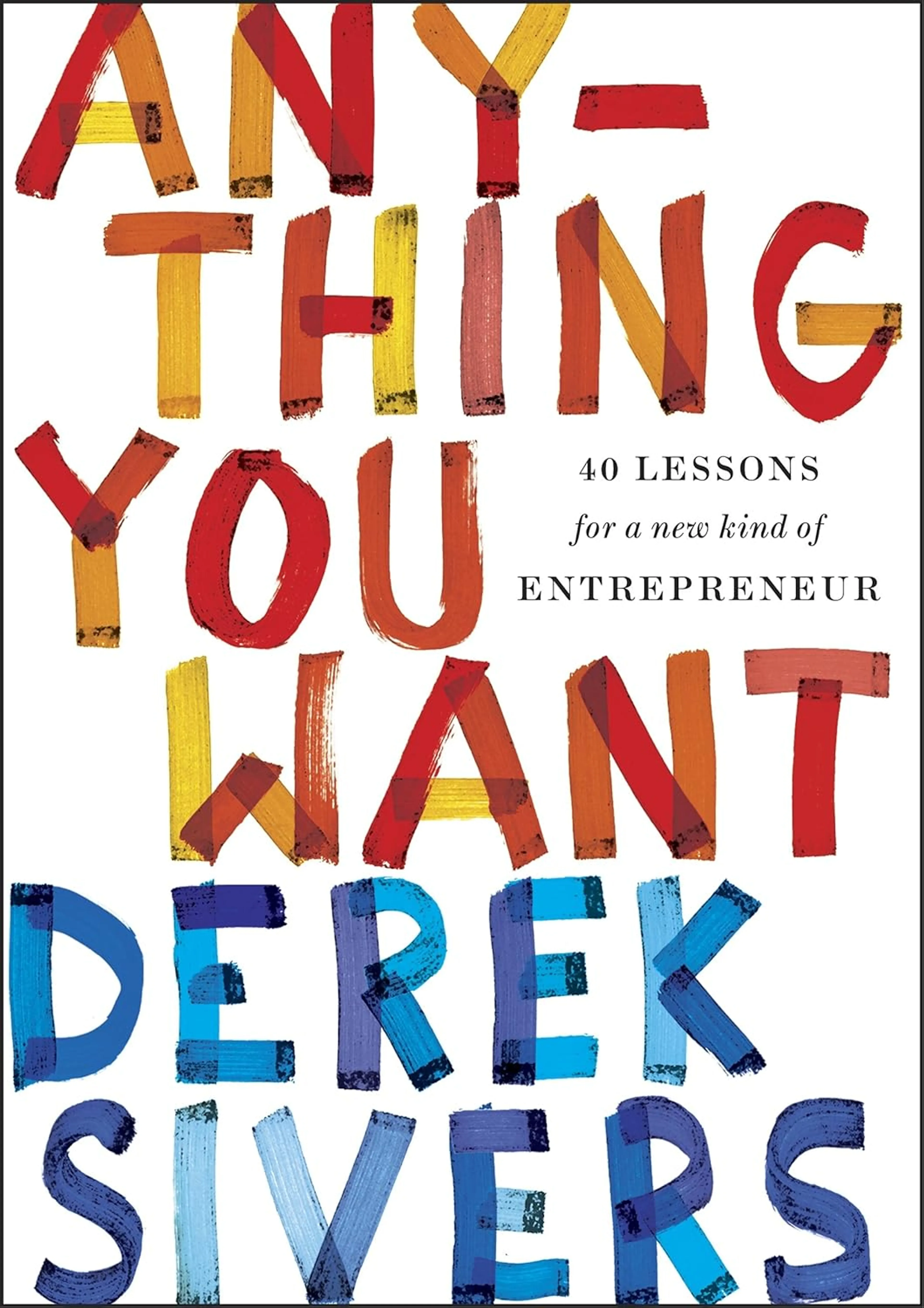
Anything You Want
40 Lessons for a New Kind of Entrepreneur
by Derek Sivers
🏆 Rated: 7/10
Summary
Anything You Want is a book about how business can (and maybe should?) be conducted. Focusing on what is fun and meaningful, rather than in what is most effective or "the right way" or "industry standard". It's reframing businesses as a creative playground where you can problem solve and have artistic expression and creation, while solving customers problems. Putting humanity and the little touches first, providing an overall better experience than what people would find otherwise, elsewhere. Doing small things, acts of kindness that come from a place of abundance, essentially sharing what you already have with others, just because that feels good to you. The compass is always the internal, what feels good to me, which is in line with what's good for the business by defintion. If you truly care about the customers problems (which you should because you want to solve it), then you should be fine if your company, one day, doesn't exist anymore because the customers problems went away entirely. In fact, a good business should sort of have this as it's north star. Money is only a means to solve the problem and keep providing that service and scaling is just a means to providing the service to everybody who needs it. If something is truly useful, no marketing is necessary, the business will double on its own and you need to keep up with the demand, and to feel like you're not always behind you need to double ahead of time. Again, abundance mindset and sharing gladly. From all this follows a lot of interesting stuff, one of my favorites being that every customer interaction should be as good as possible. Lose every fight. Make every moment count. Customer service is why a business exist. It should be an important part of the company at the same level as sales.
So yeah, this is what this book is roughly about, but with a lot more context and nuance and anecdote. It's essentially answering one small but important question: how Derek does business.
And as such there is a lot to learn.
My favorite quote from the book is probably this one:
If you think true love looks like Rome and Juliet, you'll overlook a great relationship that grows slowly. If you think your life's purpose needs to hit you like a lightning bolt, you'll overlook the little day to day things that fascinate you. If you think revolution needs to feel like war, you'll overlook the importance of simply serving people better.
Detailed Notes
The key points in one paragraph => Derek's Compass:
Business is about making dreams come true, not money. They are a great way of both improving yourself and the world. You can design your own perfect world. Business for your own gain or only for the money is bad ethics. Success => consistent improving and invention, not promotion of something that doesn't work. Business plans don't work. Only if you start something you'll get to learn what people really want. Businesses are just ways to help people. For that you don't need money. You can exclude people because you can't please everybody. You don't want to be necessary for the operation of the business. And you want to be happy doing a business, if you aren't, what's the point?
Businesses are your little utopias. You make all the rules and can create whatever you would like to see in the world. If you make your dream come true, creating something that you dreamt of would exist, then other people will also want to use it, because people are more like you than you'd think.
If you think true love looks like Rome and Juliet, you'll overlook a great relationship that grows slowly. If you think your life's purpose needs to hit you like a lightning bolt, you'll overlook the little day to day things that fascinate you. If you think revolution needs to feel like war, you'll overlook the importance of simply serving people better.
Greatness doesn't feel like revolution, it feels like common sense.
If the response to something you create isn't take my money I want this you can safely pivot and create something else instead.
If it's not a hit, switch.
No plan survives first contact with the customer.
By not having any money to waste, you never waste money.
Customer obsession, just like with Amazon, is a core value of the business Derek Sivers ran. Of you make your existing customers happy and focus on them entirely, they will get you new customers on their own.
No business goes as planned, so make ten radically different plans.
Money is secondary, businesses should be utopian they should be there to help people. Remember customer obsession.
All great service comes from this feeling of generosity and abundance. [...] All bad service comes from a mindset of scarcity.
Companies solve a problem and should be happy to die if the problem is truly solved. Again. The customer comes first.
Customer service is not an expense to be minimized. It's a core profit center, like sales. It's where you should put your best people.
Losing every fight is something good to do. It's like being Gandhi or an angel. But it also increases your own peace of mind and in business it's good for business, counterintuitively.
Behind your screen there are other people. A lot like you. With their own problems, their own internal world. Treat them like that. It's too easy to forget.
Unclear is bad. Unclear can mean too many words. Not succinct enough. Or the wrong words. Either is bad. Spending a lot of time on being clear is important. You should feel pain every time you produce words for somebody else to read, that are unclear.
It's often the tiny details that really thrill people enough to make them tell all their friends about you.
Fun little human touches are important for a company. It's the play in the business.
Being self-employed feels like freedom until you realize that if you take time off, your business crumbles. To be a true business owner, make sure you could leave for a year, and when you came back, your business would be doing better than when you left.
Book Recommendation: E-Myth Revisited - Michael Gerber
Sometimes being clueless about how the world works helps you think from first principles and come up with good or even better solutions on your own. Naivety can be a strength.
The idea of hiring and training your own replacement before quitting a job is powerful. It shows just how much Derek cares.
Once you become the boss, your opinion is dangerous.
Bosses opinions = commands. They zap autonomy and motivation. Give people ownership.
In the end, it's about what you want to be, not what you want to have. To have something (a finished recording, a business, millions of dollars) is the means, not the end. To be something (a good singer, a skilled entrepreneur, or just plain happy) is the real point. When you sign up to run a marathon, you don't want a taxi to take you to the finish line.
Never promise something that is beyond your entire control to promise. Not customers, nor other people you care. That's "the Apple lesson", where Derek promised something that relied on Apple the company doing something, then had to go back on his promise because they didn't.
You have to just do whatever you love the most, or you'll lose interest in the whole thing.
If you think of happiness as the goal, then growing the company often is not what you want. Beyond a certain point the added complexity makes more problems and more headaches and therefore detracts from your happiness. Hence, don't grow.
Make sure you know what makes you happy, and don't forget it.
Trust but verify is an important idea. When you delegate, this is necessary. If you delegate too much, there is a threshold. You abdicate, you relinquish all power, and do nothing, and hence other people might take advantage of this.
It's not that I'm altruistic. I'm sacrificing nothing. I've just learned what makes me happy. And doing it this way made me the happiest.
Following curiosity is much more fun than being idle. Even if you never have to work a day in your life.